Incubator 02 · Singapore
Hacking the Asian Waves: Shaping Cultural Flows in the Global Imagination

Hacking the Asian Waves:
Shaping Cultural Flows in the Global Cultural Imagination
26 May 2026, LASALLE, University of the Arts Singapore
Asia no longer simply participates in the global creative economy; it is actively reconstituting its architecture. We are witnessing a multipolar realignment of cultural power: ancient Chinese motifs are reinvented through diasporic design; K-pop melodies transcend linguistic and faith-based borders; and massive anime databases reveal the logic of multi-billion-dollar transmedia ecosystems.
This new cartography of Asian cultural flows is simultaneously generative, commercial, and contested. While these flows yield immense soft power, they also generate significant friction. The rise of anti-Hallyu clusters in Southeast Asia signals emerging geopolitical resistance, while the race to preserve intangible heritage faces the dual threats of algorithmic erasure and cultural homogenization. Even as Japanese anime achieves unprecedented global reach, it confronts an existential crisis: generative AI tools that extend creative possibility while simultaneously threatening the labor regimes and hand-drawn aesthetics that define the medium. To navigate this volatile terrain, intuition is insufficient. We require systematic, speculative, and methodologically rigorous foresight.
The Culture Futures Lab Incubator: "Hacking the Asian Waves" serves as the mission control for this endeavor. Moving beyond passive theoretical discourse, this immersive laboratory focuses on the engineering of cultural transmission. Participants will engage in speculative prototyping, deploying emergent technologies—including VR environments and predictive analytics—not as replacements for tradition, but as instruments to model, stress-test, and refine resilient strategies. Our goal is to ensure a future where Asian cultural forms do not merely circulate under the weight of global algorithms, but actively shape the global creative frontier.
Sprint 1: Where Dragons Wander
Remediating Chinese Motifs through VR
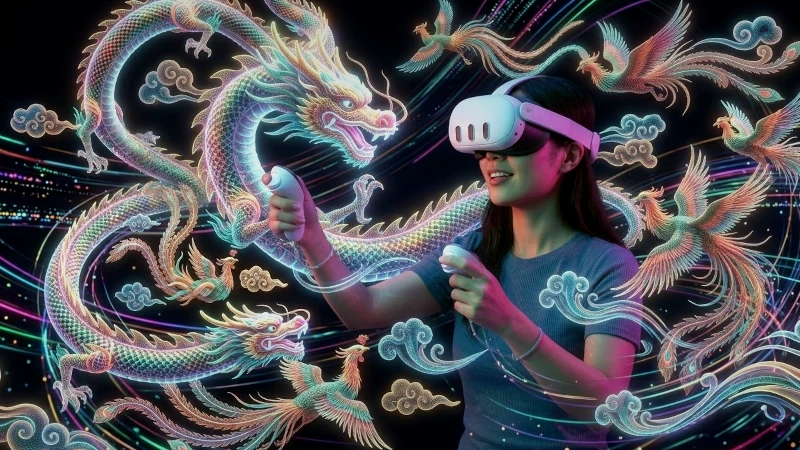
The dragon never stayed home. Neither did the phoenix, the lotus, nor the cloud scroll. Across maritime Asia, these Chinese visual symbols migrated through trade winds, marriage networks, and colonial encounters—transforming as they traveled. Today, a phoenix rendered in Peranakan beadwork or a dragon carved into a Malay keris hilt no longer belongs solely to "Chinese" heritage. Yet our archival logics persist in trapping these traveling motifs within ethnic silos, rendering invisible the hybrid narratives they now embody. This VR Sprint invites participants to become co-authors of traveling symbols, reinterpreting ancient Chinese motifs through the lens of their own cultural experiences. Using Virtual Reality as a platform for participatory remediation, the sprint enables diverse communities to encounter Chinese motifs through distinct aesthetic vocabularies. Through hands-on VR prototyping, participants will craft immersive narratives that weave Chinese symbols into their own cultural stories, transforming historical legacies from frozen archives into dynamic, shared resources.
The Sprint will raise the following questions:
- Who holds authority over symbols in motion: the culture of origin, the culture of arrival, or the spaces between?
- Can participatory VR make visible hybrid narratives that conventional archives render invisible, or does it risk producing new forms of appropriation?
- What ethical frameworks should govern the remediation of sacred or historically significant motifs across cultural boundaries?
- How do we distinguish between cultural borrowing, mutual co-authorship, and appropriation when symbols travel through immersive digital environments?
Sprint Leaders: Benedict Yu & Amber Yin
Sprint Facilitators:
- BA (Hons) Arts Management students at LASALLE, University of the Arts Singapore: Muhammad Haris, Sarah Qistina, Qing Hao, Shernice Sah, Liv Lim, Vina Tan.
- Jaime Jover, Master of Science in Technology and Design student at Singapore University of Technology and Design.
Sprint 2: Will the Korean Wave Crash?
Traversing (Anti-) Hallyu Geographies
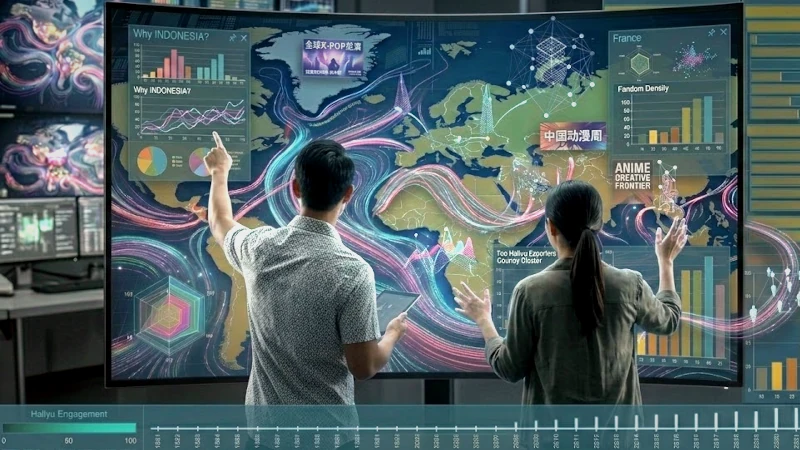
The Korean Wave does not travel through empty space. It moves through communities with existing histories, religious commitments, and postcolonial sensibilities—and sometimes, it meets resistance. Yet even as anti-Hallyu sentiment surges in some nations, fandoms in neighboring countries grow louder. The question is no longer whether Hallyu flows, but why it flows so differently across communities—and whether the rising counter-flows signal an impending crash or simply the natural friction of deep cultural engagement. This sprint places participants inside the currents of cultural transmission. Working with the Hallyu Tracker data, audiences will explore how clusters of countries—sometimes unbounded by geography or historical ties—respond similarly to Korean cultural exports. Why does Indonesia embrace Hallyu as a "K-Tsunami" while simultaneously generating sustained critiques of cultural invasion? What patterns emerge when we map pro- and anti-Hallyu movements rising in unison across seemingly disconnected territories? Through hands-on engagement with the Hallyu Tracker, participants will visualize the complex topographies of cultural reception—not to predict waves with algorithmic certainty, but to understand the deep structures that shape when and where they break.
The Sprint will raise the following questions:
- What explains the phenomenon of pro- and anti-Hallyu sentiments intensifying simultaneously within the same national contexts?
- When clusters of countries unbounded by geography or shared history exhibit similar reception patterns, what invisible structures might be shaping these alignments more powerfully than physical proximity?
- How do local communities distinguish between enthusiastic cultural borrowing and perceived cultural imperialism?
- Is cultural friction necessarily destructive, or might resistance sometimes function as a mechanism for deepening engagement?
Sprint Leader: Natalia Grincheva
Sprint Facilitators:
- Dr Hedren Sum, Research Fellow in Digital Humanities at the National University of Singapore
- Dr Danyun Liu, Research Fellow in Digital Humanities at the National University of Singapore
- Jamie Chan, Course Chair, Diploma in Arts Business Management, Ngee Ann Polytechnic
- Jimin Lee, PhD candidate in Southeast Asian Art History at Nanyang Technological University
Sprint 3: Visual Clash
Remaking the Everyday through Anime's Grammar
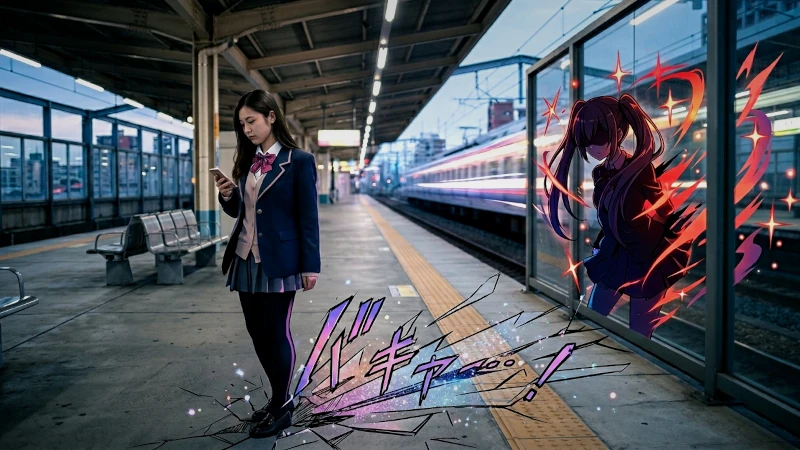
Scroll through social media and you'll see it: a quiet street overlaid with anime eyes, a train platform suddenly charged with unspoken drama. This is a visual clash—the moment anime's aesthetic cues inject ordinary spaces with new emotion and hidden narratives, all without a word of dialogue. These moments shape how we feel about places and products. Yet the visual grammar making them so potent—the archive of character designs we instinctively recognize—remains unexamined. What if we could explore its source code? This sprint invites you to dive in. Using the Japanese Visual Media Graph (JVMG) —a knowledge graph bringing together a vast ocean of fan curated data including information on thousands of characters by various traits such as eye color, hair style, age, and visual archetypes—you'll move from passive consumer to active participant. Through hands-on exploration and AI-generated images, participants will identify which traits best transform everyday scenes into storyworlds, mixing and remixing data to chart new possibilities. It will help to find out which character archetypes inject the most life into a blank template. Creating something never seen before and mapping the grammar shaping our world together, will open new possibilities for the next generation of global audiences.
The Sprint will raise the following questions:
- How does a character's design—a specific shade of violet eyes or a particular hairstyle—change our sense of a place, from a bustling city square to the corner of a coffee shop?
- What makes certain anime characters ideal for injecting commercial spaces with surplus feeling, while others hold the potential for more personal, resistant, or unexpected meanings to emerge?
- Can an atmosphere alone, evoked through color and texture, create a sense of character presence within an image, even when no literal figure is visible?
- How can we use computational tools to not just find patterns in character design, but to generate new, never-before-seen archetypes, and what new kinds of visual clash might they create?
Sprint Leader: Sheuo Hui Gan, Magnus Pfeffer & Zoltan Kacsuk
Sprint Facilitators:
- Dr Roslynn Ang, Lecturer in Arts Management at LASALLE, University of the Arts Singapore.

